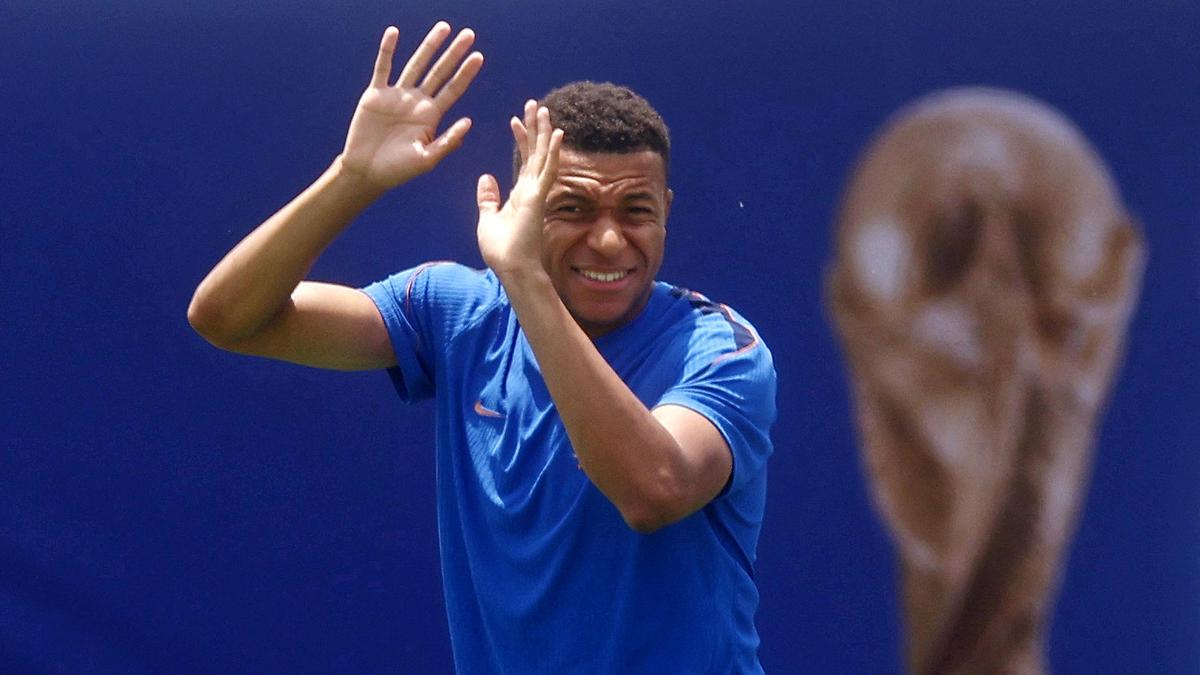

France’s Kylian Mbappe’s response to tirades of Paraguay’s Celeste Amarilla that found backing from footballing fans and even the United Nations. File
| Photo Credit: Reuters
France is gearing up to play its third consecutive semi-final at the FIFA World Cup. Having won the title in 2018 and lost the final in 2022, France is a favourite to go all the way this year too and could join West Germany and Brazil in the elite club of final ‘three-peat’ with a win against Spain on Tuesday (July 14, 2026). However, while France has been celebrated for their strong performances and champion mentality, this tournament saw them being at the receiving end of one of the most despised aspects of football, the racism that seems to be following it. From chants of people in rival nations’ jerseys questioning the heritage of French players to a Paraguayan Senator launching a blatant racist attack on the French captain and their talisman striker, Kylian Mbappe, the Blues have had to keep their focus on the ball on and off the pitch to avoid being distracted by the noises.

All the major footballing bodies, including the global regulator FIFA and the European agency UEFA, have been fighting racist incidents on and off the pitch for a long time. But the intensive campaigns and awareness initiatives seem to have done little to impact the countable portion of people who follow the game and resort to insensitive ramblings to deal with an unpleasant result. But despite the efforts from the governing bodies to protect players from such attacks, if not bring a change in the ‘ultras culture’, — a phenomenon in both club and country football where set of people establish themselves as a team’s hardcore fans and give themselves the privilege to resort to any means to demotivate opponents — online abuses and racial chants targeting specific players have gotten out of hand during the current edition of the tournament and players found themselves having to speak up instead of focusing on the game.
Mbappe’s response to tirades of Paraguay’s Celeste Amarilla that found backing from footballing fans and even the United Nations, and the legal actions being sought against her, brought the attention of many, given the high-profile back-and-forth that took place. However, not every player has the status of Mbappe to respond to abuses without messing up their mental state, and many are finding their social media accounts filled with insults and abuses for something as trivial as missing a pass or failing to convert a shot.

“Players shoulder the expectations of a nation, but this must never come at the cost of their safety, dignity or wellbeing, nor should abuse be dismissed as part of the game,” FIFPRO, an international organisation of professional footballers, said in a statement last week in response to the growing instances of racial and discriminatory abuses directed at the players. “In recent weeks, players have faced abuse online and in person, much of it racist and discriminatory. There has been intimidation and hostility beyond the pitch. These incidents are not isolated; they point to a systemic pattern that cannot remain an accepted part of football or society”, it said while calling for “collective action to protect players from a growing pattern of abuse that encompasses some media coverage, the aftermath of matches and team eliminations”.
While FIFPRO pointed at systemic pattern of abuse, it is paradoxical to contemplate that the game, fondly called by fans the beautiful game for its emotional impact on generations around the world, could be a system of abuse and insult. Most of the abuses circling football comes from the ‘manosphere’ that follows the game, and (while it would need psychological surveys to confirm this) the result of the fragile egos finding solace in systemic discrimination inherent in many modern societies. But it is not just in the gallery that racism, which UEFA says has no room in the game, finds space.

The 2026 World Cup brought in many rule changes to the game, aiming at making it more efficient. Among the changes was the Prestianni rule, notoriously named after Gianluca Prestianni, an Argentine international who was sanctioned last year for racial remarks against Brazilian star Vini Jr. During a club match for Benfica against Real Madrid. Prestianni used his palms to cover his mouth while making the remarks against Vini to make sure that the camera did not capture the lip movement, but it was picked up by the players and led to a ban for multiple games for Prestianni. FIFA introduced the new rule to discourage players from hiding behind the safety of unreadable lips to insult opposition players, sanctioning the act of covering the mouth while interacting with the other team as a red-card offence, with Paraguay’s Miguel Almiron being the first one to be punished under this rule during the group stage match against Turkiye.
Rising instances of racism
The FIFA Social Media Protection Service, an initiative to protect teams from being exposed to abusive and racist content online, scanned around 6 million posts and comments online during the group stage and flagged around 89,000 abusive contents, of which FIFA said 11% were racially motivated attacks. FIFA noted that, while this is only around a 3% increase from the same stage during the 2022 world cup, the content has become worse in terms of the use of abusive language.
While hateful language by fans is present unabated at one side, another form of racism has become institutionalised in the game. A recent study on bias in commentary on players, published by The Conversation, noted that people in the studio preferred to describe mental characteristics, like intelligence and calmness, of fair-skinned players while darker-skinned players found their physical traits, like size and strength, being admired during the games. The difference is merely a reflection of the institutionalised racism prevalent in American and European nations that is hard to notice in normal conversations.
Football has always been a game of beauty and perseverance, and as the UEFA tagline goes, there is no room for racism in it. But the reality is, from Pele and Eusebio to Mbappe and Vini Jr., artists of the game have had to listen to chants on their skin colour instead of their footwork at least once in their career, which is one more than the preferable number. And while these players answer to abuses with the ball on the ground, the culture is not something fans of the beautiful game should tolerate.
Published – July 14, 2026 08:53 am IST